Quick note to bring you up to speed what happened for the past 30 days
### 1. **Why the U.S. Government Shutdown Isn’t Shaking the Markets**
The U.S. government is shut down since 1 Oct, but guess what? The stock and bond market don’t seem to care.
Even though this is the second-longest shutdown in U.S. history, the market has been climbing for the past 30 days.
Sure, there was a hiccup in mid-October when former President Trump threatened a 100% tariff on China.
But overall?
The market is steady. I know of people who panic sell when this happens.
What they didn’t know is that the market has historically shrugged off government shutdowns. Sometimes, inaction is actually the right action.
### 2. **Earnings Season: Winners, Losers, and What’s Next**
Corporate earnings season is here, and it’s a mixed bag. Big banks in the U.S. are reporting solid profits, but not everyone is winning.
Tesla and Netflix fell short of expectations, which shook some investors.
All eyes are on trade talks between the U.S. and China.
President Trump and China’s Xi Jinping are set to meet. These talks could impact everything from tech stocks to global trade, and the outcome could shift the market dynamics in the short term.
### 3. **Is AI the Next Big Bubble?
AI is the talk of the town, but is it a bubble waiting to burst?
Some people think it’s like the dot-com crash 25 years ago.
But here’s the twist: experts, including Goldman Sachs, say this time is different.
AI companies today are backed by real growth and profits, not just hype.
Sure, there’s always a chance of a bubble, but AI seems more stable and profitable than the tech boom of the early 2000s.
Capture the upside now, so even if it corrects going forward, won’t be in the ‘net negative.’
### 4. **Locking in Bond Yields**
On another note, with interest rates expected to drop, bonds issued from last year up until current ones are becoming more attractive.
Here’s why: when rates go down, bond prices go up. Plus, bonds can offer better returns than just keeping your money in cash.
Why should you care? Locking in today’s bond yields could mean steady income and strong returns, no matter what happens in the economy or stock markets.
### 5. **China’s Stock Market: A Comeback Story?**
China’s stock market has been struggling for four years, but things are looking up. Goldman Sachs predicts a 30% gain in China’s key stock index by 2027.
Why? Pro-market government policies, rising profits, and strong money flows are driving the recovery.
The fuel behind the surge this year? Ordinary Chinese households, flush with record savings. Total Chinese household savings currently stand at more than 160 trillion yuan ($22 trillion). Retail investors dominate China’s onshore stock markets, accounting for around 90% of daily trading, according to HSBC data.
That’s a sharp contrast with major global exchanges, where institutions lead activity—on the NYSE, for example, individual investors make up only 20%–25% of trading volume.
Naturally high emotions lead to high volatility. But there’s a catch: the U.S.-China trade war could still shake things up. Concentrated and/or rigid exposure is not recommended.
### 6. **Asset Price Inflation to Outpace Inflation Itself?**
Stock markets keep climbing not due to luck—but really due to something called asset price inflation.
When interest rates are low, borrowing money gets cheaper. Companies invest more, grow faster, and make more money.
Some even raise prices, like Apple, Netflix and Spotify, and pass the costs to customers (without losing too many customers, unlike, say, Astro).
With higher profits, companies can buy back their own stock, making shares, perceptibly, more valuable (rise in demand).
Of course, it drops not due to ‘deflation’ but simply due to mass sell-off (massive drop in demand), which is caused by fear & lack of security.
Even if the stock market dipped 20-30% in a broad market downturn (eg 2022), a thoughtfully diversified stock portfolio can always bounce back – just give it time.
After all, there are really not many asset classes to outpace inflation and maintain standard of living, in the long run (> 5 years)
### 7. **The Fed’s Big Moves: What It Means for You**
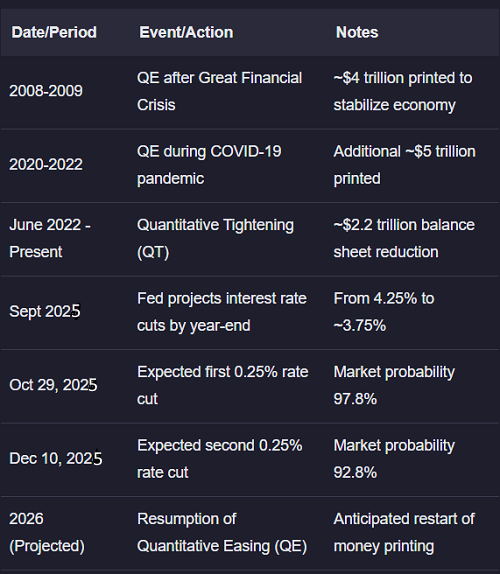
The Federal Reserve, America’s central bank, is shifting gears. They’re ending their “quantitative tightening” phase, where they reduced the money supply, and moving back to “quantitative easing,” which increases it.
Why does this matter? More money in the system can boost the economy and markets.
News Headlines that Matter
| S&P 500, Nasdaq rise as investors look past hawkish talk, await shutdown clarity |
| Wall Street ends streak of weekly gains, yields rise as investors digest data |
US stocks kick off week with small gains; yields dip
| US equity raising tops US$255 bil as recovery hits third year |
| US stocks end strong quarter with moderate gains |
Equities rise as traders look beyond US shutdown; currencies muted
Stocks mixed, gold hits record as US govt shuts down
| Stocks and euro tick higher as France undergoes confidence votes |
| Stocks and euro tick higher as France undergoes confidence votes |
| S&P 500 climbs 1% as earnings kick into high gear |
| Asian stocks surge on Trump-Xi meeting confirmation |
| European stocks steady as traders wait for US inflation data |